Fundamental Symmetries
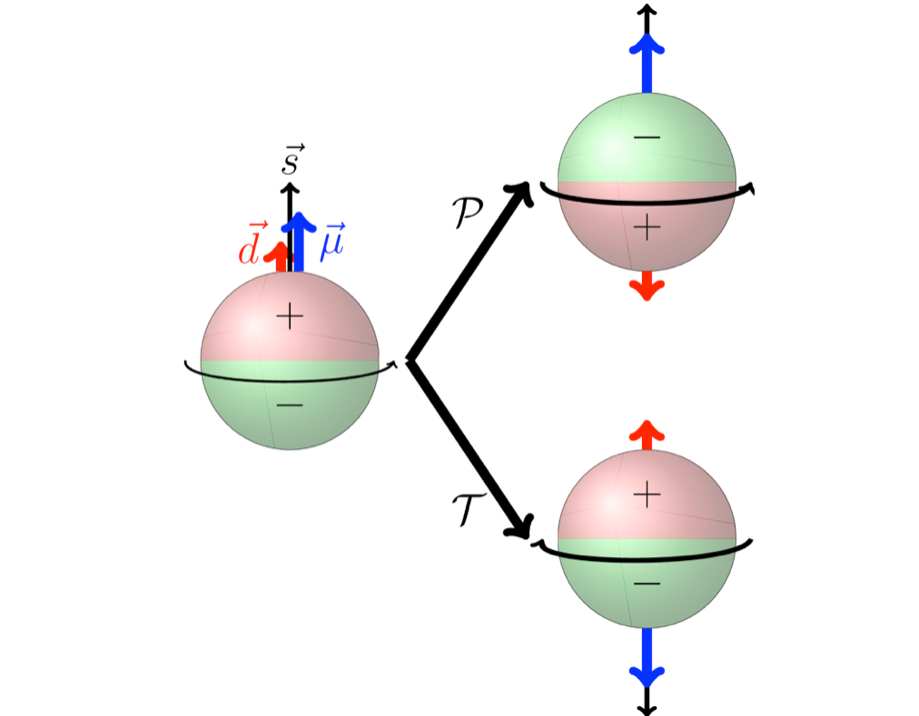
The reason why the Universe we observe today is dominated by matter over antimatter is still unknown and represents one of the big questions of modern physics. A tiny amount of combined charge conjugation (C) and parity (P) symmetry breaking must have driven the evolution of the Universe to the way we observe it today. The mystery though is that the fundamental interactions of particle physics do not contain enough CP-violation to explain the asymmetry we observe today. This observation points towards the existence of new physics containing new sources of CP-violation. Intrinsic electric dipole moments are a signature for CP-violation and the neutron provides an ideal system both experimentally and theoretically. After 65 years of attempts though we still have no experimental evidence of a neutron electric dipole moment and at the same time we still lack a precise theoretical determination.
The focus of this research thrust is to provide a precise calculation from first principles of the neutron electric dipole moment induced by new sources of CP-violation. To reach such a goal we are going to solve non-perturbatively the theory of strong interactions, Quantum Chromodynamics (QCD), defining it on a space-time lattice.
To overcome the technical and conceptual difficulties that have hampered in the past this calculation, we will use a combination of innovative tools, such as the gradient flow to renormalize the CP- violating sources, and a novel QCD discretization, Stabilized Wilson Fermions, to control continuum limit and chiral extrapolation. The combination of these new ideas and technical developments will allow a precise calculation of the neutron electric dipole moment stemming from new CP-violating source, thus providing the theoretical result for the interpretation of future experimental measurements and a key step in the explanation of why the Universe is currently dominated by matter.
Θ-term
The so-called θ-term is a CP-violating contribution to the dynamics of the strong interactions. The parameter θ measure the amount of CP-violation. A non-vanishing θ can induce a contribution to the neutron electric dipole moment. The current experimental bounds restrict its value to be of the order of |θ| ∼ 10-10, thus unnaturally small. This is the famous strong CP-problem: why is the θ-term so small? One possible answer comes from the existence of another particle, yet undiscovered, called the axion that could provide a dynamical explanation as to why θ vanishes.