Hadron Structure
Quantum Chromodynamics (QCD), the theory of strong interactions, comprehensively describes the interactions between quarks and gluons across a broad energy spectrum, including the binding mechanisms between these elementary particles. QCD is non-perturbative at low energies, presenting a challenge in applying perturbative methods for the analysis of hadron structures.
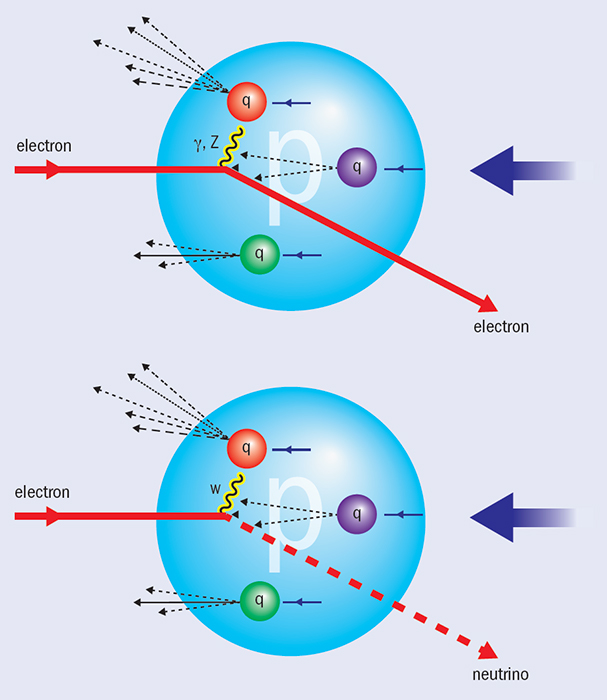
The study of hadron structure relies on the parton picture, where the dynamics of quarks and gluons are characterized by parton distribution functions (PDF).
The precision of QCD calculations is intricately tied to the accuracy of these PDFs, and this connection plays a crucial role in current measurements at the LHC. It will continue to be essential for future investigations at the EIC, HL-LHC, and LHeC. The current and future search for new physics depends heavily on the precision of the comparison between experimental data and theoretical predictions. This underscores the importance of a precise determination of PDFs.
The understanding of collider processes based on QCD factorization allows for the study of hadron structure using PDFs. Going beyond PDFs, generalized parton distributions (GPDs), and transverse-momentum-dependent distributions (TMDs) complement the 3-D description of hadrons. Although all the distribution functions are not directly measurable, they can be determined by factorizing the hard and soft parts of the cross-section of the process of interest.
Lattice QCD can offer a theoretical input for the determination of the PDFs and their evolution. The direct calculation of PDFs using lattice QCD poses particular challenges due to the Euclidean geometry and the light-cone dominance of the kinematics. The connection between PDFs and hadronic matrix elements, which are calculable in lattice QCD, is established through the moments of the PDFs.
In this research thrust, we propose a method that addresses both the theoretical and numerical challenges faced in the past, which hindered the calculation of moments of any order from lattice QCD.
Non singlet twist-2 operators