Precision Physics
About 95% of the observable mass in the Universe is a result of quarks binding into nucleons through the strong interactions of quantum chromodynamics (QCD). The slight mass difference (approximately 0.07%) between protons and neutrons is attributed to isospin symmetry breaking in the Standard Model. This breaking is due to differences in the masses and electric charges of down and up quarks. Despite the small magnitude of these effects, they play a crucial role in our comprehension of the Universe. For instance, the early Universe’s primordial abundance of light nuclear elements is highly sensitive to the neutron’s excess mass compared to the proton.
Lattice QCD (LQCD) offers a fundamental approach to assess isospin-breaking effects in hadronic and nuclear processes. Several LQCD calculations have been conducted on the strong contribution to nucleon mass splitting, as well as electromagnetic corrections.
While incorporating electromagnetism into Lattice QCD (LQCD) is theoretically uncomplicated, it poses practical challenges due to the long-range characteristics of electromagnetic (QED) interactions. In particular, these interactions result in finite-volume (FV) corrections following power-law patterns. Removing these corrections through extrapolation involves computationally demanding simulations conducted across multiple volumes. An analytical comprehension of the power-law finite-volume effects within such configurations has facilitated dependable extrapolations of the single hadron spectrum.
QEDM: massive photons on the lattice
Despite the effective use of existing techniques, there are compelling reasons to explore new methods. Achieving control over finite-volume (FV) modifications to light nuclear binding energies often necessitates exceptionally large volumes. Beyond the spectrum, precise knowledge of Quantum Electrodynamics (QED) modifications is essential for various quantities, such as corrections to hadronic matrix elements and charged particle scattering, both facing challenges in the infrared (IR) range. While Lattice QCD (LQCD) calculations employ multiple ultraviolet (UV) regulators, offering valuable checks on the continuum extrapolation of crucial quantities, incorporating multiple IR regulators is crucial for LQCD calculations involving QED. However, only a few formulations have been explored to date, with only one constructed using a local quantum field theory. Additionally, having computationally efficient methods to account for IR effects is desirable not only for lattice QCD+QED but also in scenarios where long-range Coulomb interactions are present.
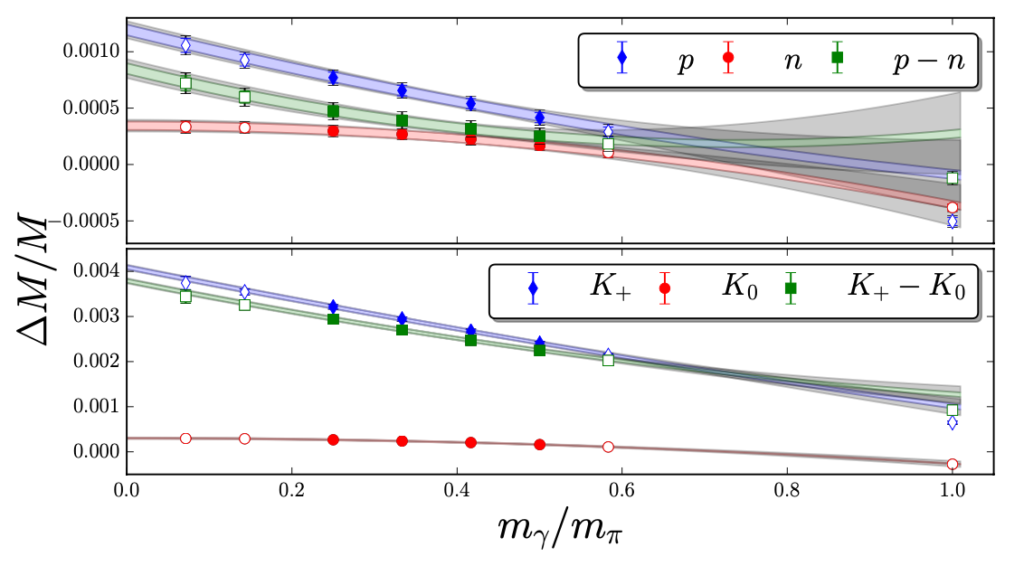
Motivated by these considerations, we illustrate the feasibility of an alternative IR regulator for lattice QCD+QED simulations: specifically, introducing a photon mass, denoted as mγ.